Libby Munro
The Death of Bunny MunroLibby Munro is Bunny Munro’s wife and Bunny Junior’s mother. Her death by suicide is the central loss around which the novel’s family story turns, but the surviving details do not resolve her life into a single explanation: distress, fragments of domestic memory, and the ways her husband and son continue to imagine her remain in tension. She is both a person whose crisis is glimpsed but incompletely known and an enduring presence in the memories of those she leaves behind.
Identity and Final Crisis
In a phone call with Bunny Munro shortly before her death, Libby says that she is frightened of everything. Bunny notices a change in her voice and asks whether she has been taking Tegretol, but the conversation does not establish whether she has stopped taking it or explain the nature of her condition. She also tells him that his father has called again, shouting and raving, and that she does not know what to say to him. Her account places her fear alongside pressure from Bunny Munro’s family, while leaving the circumstances of her distress unresolved.
The call exposes a gap between the spouses’ understanding. Bunny initially tells Libby that she has nothing to fear and warns her against talking that way; only as her distress becomes harder to ignore does he recognize that something has changed. His alarm comes through, but the scene does not provide an account from Libby beyond what she says in the conversation. The novel therefore makes her crisis consequential without giving the reader a definitive diagnosis or a complete explanation of her thoughts.
Death and the Fragments Left Behind
Bunny Munro and Bunny Junior discover Libby after she has died by suicide at home. Bunny reacts with shock, while the boy, already in the room, keeps his attention on the television and then the carpet. The scene establishes their differing responses to the same loss: Bunny confronts the fact directly, while Bunny Junior’s perception narrows to ordinary details. Later, Bunny watches attendants carry her out on a gurney and place her in an ambulance. The procedure seems routine to him, a stark contrast to the personal catastrophe unfolding for the family.
After her death, the family learns details that do not combine into a settled account of what happened. At the funeral, Bunny and his son wear black suits that Bunny found in an otherwise empty bedroom closet. A receipt showed that Libby had bought them at Top Shop in Churchill Square two days before her death. The purchase is concrete, but its purpose remains unknown to Bunny and the narrative; it cannot, by itself, explain her intentions.
A neighbor also reports seeing Libby burn pieces of paper and drop them over the balcony a couple of days before she died. Bunny identifies the scraps he finds under the stairwell as love letters he had written before their marriage. Their destruction gives him another troubling fact to interpret, but no explanation from Libby accompanies it. At her service in St Nicolas Church in Portslade, Father Miles describes her as lively, loved, selfless, and generous. He does not mention her medical condition or the manner of her death, referring instead to her premature departure. The formal eulogy and the private, unsettled questions around her death occupy separate registers: one offers public praise, while the other leaves Bunny searching for meaning.
Motherhood and the Son’s Memories
For Bunny Junior, losing his mother also means fearing that he will lose the memory of her. As he lies in bed watching light move across the ceiling, he listens to his wristwatch and imagines that each tick carries her further away. He deliberately searches his mind for scenes that might preserve her: picking him up from school in a pink velour tracksuit, tending to his bloody nose, applauding when he rode his bicycle without holding the handlebars, and giving him an encyclopaedia because she loved him. He also reaches toward less certain memories, including an image of himself as a newborn with her hand on his forehead. Remembering becomes an effort to keep a relationship active in the face of absence.
His knowledge of facts cannot protect him from this fading. He can recall when the Eiffel Tower began to be built, yet struggles to picture his mother. He tries to arrange their shared experiences like exhibits in the Booth Museum, but the scene of her pushing him on a swing leaves him unable to see who is doing the pushing. In his mind, she becomes an incomplete image, and he feels suspended without the person who once guided the movement. The contrast between his ordered store of information and his unstable personal memories makes his grief specific: knowing more does not mean he can recover her face.
Visions and Continuing Presence
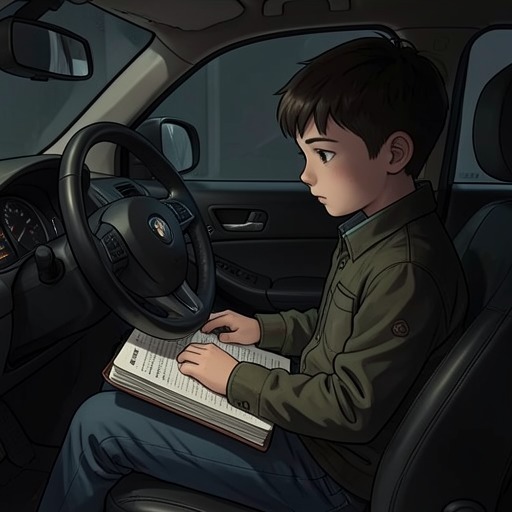
The novel presents Libby’s return through the perceptions of her husband and son, not as an independently verified supernatural event. While Bunny Junior waits in the Punto on Meeching Road in Newhaven, he believes his mother may find him. He senses her presence and hears a voice telling him that he is the most luminous object in the universe. Later, amid mist, he sees her in her orange nightdress, steps out of the car, and sits beside her. He apologizes, and the figure comforts him. The encounter gives shape to his longing for maternal reassurance, while remaining within a narrative that marks such appearances as visions.
Bunny Munro’s final encounter with Libby has a different emotional charge. During a public scene of apology and forgiveness, he sees her through the crowd and asks her to forgive him. When he speaks of being haunted, she denies that she ever haunted him, then tells him she will see him shortly and disappears. The exchange does not settle whether Libby is present beyond Bunny’s perception; it does distinguish her from the accusing presence he has feared. Across these scenes, her absence is not simply erased or overcome. Bunny Junior’s imagined mother offers comfort, while Bunny Munro’s final vision answers his guilt with a denial of haunting and a promise of reunion that remains ambiguous.
Narrative Significance
Libby’s character is constructed through limited evidence: a distressed call, objects and reports discovered after her death, the funeral, and the memories or visions of her family. This unevenness matters. Her husband and son continue to make meanings from what remains, but their grief cannot turn those fragments into a complete account of her inner life. The new suits and burned letters invite questions without answering them; the son’s memories preserve affection even as their details fade; and the final appearances keep Libby emotionally present without resolving the boundary between memory and vision. She is therefore central not because the novel explains her fully, but because her absence reorganizes the lives and perceptions of those who survive her.